
 Cooking training
OSRS Cooking 1–99 Guide
Cooking can be fast, inexpensive and easy to fit around another activity. Decide whether you want the cape quickly or a bank of useful food, then choose a method whose burns and buying cost make sense at your level.
Updated
Fast levels or food you will use?
Cooking is mostly a banked skill: buy or catch raw food, cook it and repeat. Burns make early recipes less efficient, while better ranges and equipment help as you progress. You can pay for very fast XP, use longer inventories for a quieter session, or build a useful food stack.
Starting at level 1? See the quest route ↓Start at level 4 with Cook’s Assistant
Optional quest route · order, requirements and next training method
You only need a short stop in Lumbridge to skip the first Cooking levels and unlock a useful range. This works in free-to-play too.
Level 1 → 4 +300 Cooking XP
Cook’s Assistant
Before you start: An egg, a bucket of milk and a pot of flour; no skill requirements.
Speak to the cook in Lumbridge Castle’s kitchen and deliver the ingredients. You can collect all three around Lumbridge without buying them from another player.
Continue from level 4
Cook sardines or other low-level fish you already have until 15, then move to trout. Use the castle range after the quest for its lower burn chance on supported foods.
Go to the training instructions →Levels count the XP listed above from a fresh start. Making your own supplies, quest fights or optional lamps can put you further ahead.
If you intend to use karambwan, complete Tai Bwo Wannai Trio and talk to Tinsay afterwards to learn the edible recipe. The normal cooked fish requires that instruction; choosing the poison version is a different recipe.
Fastest Cooking training
One-tick karambwan is the speed route. Wines are a simpler fast alternative if you prefer a short bank-and-mix cycle.

Levels 1–30: One-tick poison karambwan
The fast Cooking opening does not need Tai Bwo Wannai Trio. Poison karambwan gives 80 XP per success and cannot be sold.
Getting there
Use the bank-adjacent fire beneath the Burthorpe pub in Rogues’ Den. Bring raw karambwan; the bait fish, karambwanji, is a different item.
Bring and unlock
Place the bank, fire and inventory close together on screen. The poison recipe needs no quest. At level 1, expect most attempts to burn; 168 successes reach 30, and around 500 raw karambwan is a useful initial buying allowance.
- Use a raw karambwan on the fire and hold the key for the poison recipe. Repeat the use-item action once each game tick, every 0.6 seconds.
- Bank or drop the outputs and repeat. These poison karambwan are training waste, not healing food or a GE income.
- At 30, switch to the 190-XP edible recipe if you have completed Tai Bwo Wannai Trio and learned it from Tinsay. Otherwise use the ordinary fish route while working on that unlock.
Start with a single inventory and find a steady rhythm. Burning food and missing ticks are different losses: Cooking levels improve the former; practice improves the latter.
Same one-tick rhythm as edible karambwan, but 80 XP per success and a high burn rate at the opening levels.
Cook poison karambwan to 30 for a fast opening, then switch to properly cooked karambwan after completing Tai Bwo Wannai Trio and learning from Tinsay. The poison option needs no quest but produces unusable food.

Levels 30–99: One-tick karambwan
Worth learning if you enjoy precise clicks and want to finish Cooking quickly. Begin with one inventory at a time.
Getting there
The Rogues’ Den fire is an accessible bank-adjacent choice. Myths’ Guild works after Dragon Slayer II; a longer bank trip makes mistakes easier and lowers the rate.
Bring and unlock
Learn Tinsay’s edible recipe first. Position the bank, inventory and fire so each action is easy to target. Use a normal range/fire setup for the planning benchmark; Hosidius is too far from its bank to assume the same 5,000 attempts.
- Use raw karambwan on the fire while holding the key for the thoroughly cooked option.
- Repeat the use-item action every game tick. Each game tick is 0.6 seconds; the useful target is a steady accepted action, not extra clicks between ticks.
- Bank quickly and repeat. Practise a slower consistent rhythm before comparing your hour with an efficient demonstration.
Practise a few inventories before buying supplies for the whole goal. Include banking and mistakes when checking your XP per hour; the rate during one clean inventory is harder to sustain.
5,000 attempts/hr at a bank-adjacent fire, with burns included. A practised benchmark, not a beginner promise.
After learning proper karambwan cooking, use the one-tick method from 30 to 99. Burn losses are higher early on; start with a small batch before committing to a long goal.

Levels 35–99: Jugs of wine
Combine grapes with jugs of water, then let the wine ferment for Cooking XP. Each successful jug gives 200 XP. You can keep making inventories at a bank, so this is much faster than most ordinary fish cooking.
Getting there
Use any bank booth or chest. Making wine does not need a fire or cooking range.
Bring and unlock
Withdraw 14 grapes and 14 jugs of water. Set bank quantities to 14 so you do not accidentally fill the inventory with one ingredient.

 14 grapes + 14 jugs
Use grapes on a jug of water and make the batch. Bank the unfermented wine and withdraw the same supplies again.
 Let the wine ferment
Stop making wine for 12 seconds to let the stack ferment. Successful jugs give 200 XP each; some can fail before level 68.
- Use grapes on a jug of water and make the inventory of unfermented wine.
- Bank it and repeat. Fermentation happens after 12 seconds without making another wine; new wine restarts that timer, including for wine already in the bank.
- Below 68, let batches finish regularly so the level gains improve the next batch’s success chance. At 68, bad wine stops.
The XP appears when wine ferments, not when you mix it. A long unfermented stack uses the level at fermentation for its batch rolls, so early results can vary more than single-item averages suggest.
2,450 attempts/hr, reduced by bad-wine chance below 68. Let batches ferment as you level.
Make wine from 35 to 99 if speed matters more than producing food. Some batches fail before 68, so allow for those losses early on. At 68 that failure risk ends; the mixing routine does not change.
Low-attention Cooking training
Use Cook all with a full inventory, then return when the last item finishes. The main choice is whether a shorter bank trip is worth a higher burn chance.

Levels 1–99: Cooking fish
The banking loop stays the same as you move through fish. Your range, gauntlets and level determine how much of the raw stack turns into usable food.
Getting there
The fire beneath the Burthorpe pub in Rogues’ Den sits beside a bank and has no quest requirement. A range in the Myths’ Guild is another bank-adjacent option after Dragon Slayer II. Hosidius’s kitchen requires the easy Kourend & Kebos diary.
Bring and unlock
Withdraw a full inventory of raw fish. Cooking gauntlets reduce burns for lobster, swordfish, monkfish, shark and anglerfish. Hosidius kitchen requires Kourend & Kebos Easy and reduces burns further, with a larger bonus after Elite.
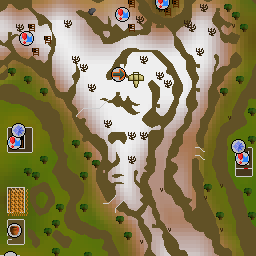
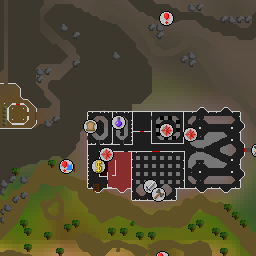
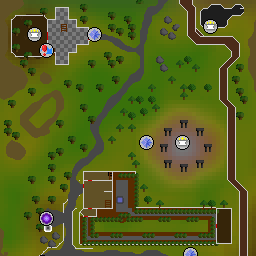
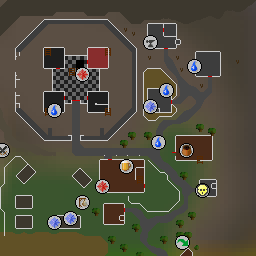
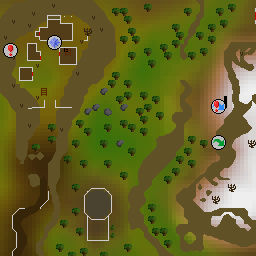
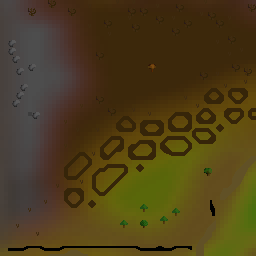
Use a games necklace to Burthorpe, then enter the pub and climb down its trapdoor. The fire and banker are together underground.
- Use a raw fish on the fire or range, choose Cook all and let the inventory finish.
- Bank the cooked fish and burns, withdraw another batch and repeat. Cooked fish and raw fish have separate GE prices, so check the spread before buying a long grind.
Levels 1–15: Sardines
A cheap starting fish. You will burn a noticeable share at low Cooking, so buy a little more than the successful-cook count.

Levels 15–25: Trout
A useful step up if you have fly-fishing supplies. There is no reason to discard a stored trout stack just because another fish has unlocked.

Levels 25–30: Salmon
Cook salmon from a fly-fishing grind or buy a short batch to reach tuna. These opening stages are brief.

Levels 30–40: Tuna
An inexpensive bridge into lobster, wine or karambwan. A basic range works; Hosidius reduces burns if you have access.

Levels 40–68: Lobsters
A simple middle-level method. Cooking gauntlets substantially reduce the raw-fish waste, so this is a good point to finish Family Crest.

Levels 68–80: Swordfish
Use them later in the fish route when burn rates are more comfortable. A range helps compared with a fire; at Hosidius, gauntlets do not add a second swordfish bonus.
Swordfish unlock at 45, but this fish route waits until 68 to reduce burns. Keep cooking lobster if its cost per XP is better with your kitchen and equipment.

Levels 80–84: Sharks
Useful 20-HP food. The unlocked recipe alone is not enough to justify buying thousands without checking your range and gauntlets.

Levels 84–99: Anglerfish
Useful for pre-pot food and later PvM. Keep gauntlets equipped and compare your burn-adjusted cost with sharks before committing to the last stretch.
You can still burn fish after unlocking the recipe. Buy extra raw fish for those failures, or stay with a lower-level fish until the better recipe is worth the losses.
Compare XP rates for these methods
Burn-adjusted pace for your selected range and gauntlets, including ordinary banking.
Start with sardines, then work through the fish below as your level rises. These are useful training brackets, not a rule to buy the most expensive fish you can cook. Keep a cheaper fish longer if burns or prices make the next one poor value.
Levels 30–99: Karambwan with Cook all
A relaxed way to build a food stack you will use on an Iron, and often an inexpensive method on a main.
Getting there
Use the Hosidius kitchen when its reduced burns outweigh the longer bank trip, or a bank-adjacent fire at Rogues’ Den.
Bring and unlock
Complete Tai Bwo Wannai Trio and learn from Tinsay. Bring raw karambwan, not raw karambwanji bait.
- Use a raw karambwan on the cooking surface and choose the thoroughly cooked option.
- Let the inventory cook, then bank and repeat. Check that the result is the edible cooked karambwan rather than the poison recipe.
Normal cooking and one-tick cooking have the same XP per success. The difference is how many attempts you complete, not a secret XP bonus.
Ordinary four-tick cooking with banking; gauntlets do not improve karambwan success.
From 30, cook karambwan with make-all for a useful food stack and short breaks between inventories. You can stay to 99. Switch to manual one-tick cooking only when you want the extra speed and clicks.
A nearby bank or fewer burns?
Ordinary cooking takes four ticks per food. A full inventory gives roughly a minute between banks. Short banking paths matter, but below no-burn levels a range that saves more fish may beat the closer fire.
Hosidius requires the easy Kourend & Kebos diary. Its success bonus is 5%, rising to 10% with Elite. Choose it in the planner only when you have that access. The Myths’ Guild range needs Dragon Slayer II; Rogues’ Den’s fire has no quest requirement.
Cooking gauntlets from Family Crest affect lobster, swordfish, monkfish, shark and anglerfish. Their interaction with a range differs by food: notably they do not improve karambwan, and do not further help swordfish at Hosidius.
Other worthwhile methods
Your own raw food and account unlocks can make a different recipe more useful than the fastest buyable.
Bake pies for Cooking and Magic together
With 65 Magic and Lunar Diplomacy, Bake Pie cooks a whole uncooked pie without any chance of burning it. Each cast takes three ticks and also gives 60 Magic XP. Use a steam battlestaff for unlimited fire and water runes, bring astral runes, and bank 27 uncooked pies at a time.
A practised banking loop handles about 1,885 pies per hour. At 60 Cooking, mushroom pies give about 377k Cooking and 113.1k Magic XP/hr; at 95, summer pies give about 490k Cooking with the same Magic XP. The three-tick limit before banking is 2,000 pies per hour. Check the price and available supply of uncooked pies before committing: the faster cast is useful, but thin GE volume can make a large order expensive.
Keep food for the jobs it does well
Karambwan can be eaten immediately after an ordinary food for a large burst of healing. They are worth banking alongside your main food rather than replacing every fish with one type. Anglerfish are useful for healing above normal Hitpoints before some encounters.
Wines lower Attack when drunk. They are cheap healing for activities such as blackjacking, but a poor default food for melee training. On an Iron, your Fishing and Hunter routes may already supply enough food to reach your next Cooking target without a shopping trip.
For F2P, fish and wines both work. Use an accessible range such as Al Kharid or Lumbridge; remove the members-only gauntlets and Hosidius settings. There is no need to assume a members’ bank layout to calculate your fish quantities.
Time and cost for your goal
Burned fish consume a raw item without producing saleable food or Cooking XP. Use your actual Cooking level, location and gauntlets when comparing costs. Wines and one-tick cooking buy speed through more frequent banking and clicks.
Plan your Cooking route or compare method quantities and costs.
Choose your next goal
Open the Cooking Training Planner for your method switches and time budget, or compare one method’s quantities in the Cooking Calculator.